











Dr. Yunus Reaffirms Responsibility Amid Rumors



Faiz Ahmad Taiyeb, Special Assistant to the Chief Adviser of the Ministry of Posts, Telecommunications, and Information Technology, retracted a Facebook post on Friday in which he claimed that the Chief Adviser would not resign. In a follow-up post, Taiyeb wrote, "The status regarding the Honorable Chief Adviser sir is my personal opinion. I kindly request not to make it into news. Thank you."
Despite the attempt to clarify, developments the following day seemed to echo Taiyeb's original remarks. After a closed-door meeting of the Advisory Council on Saturday (May 24), held following an ECNEC session, Planning Adviser Dr. Wahiduddin Mahmud conveyed the Chief Adviser’s position to reporters, stating, “He (the Chief Adviser) did not say he would leave. He said we must fulfill the responsibilities assigned to us. Many obstacles have been created in carrying out these duties. We must overcome all obstacles and fulfill our given responsibilities. The country’s long-term future depends on these responsibilities. We cannot abandon them.”
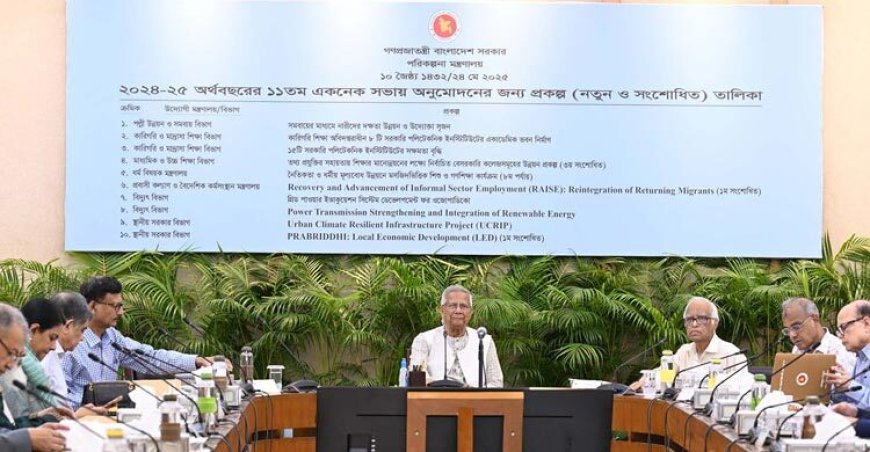
The Advisory Council meeting commenced at 12:20 PM in the NEC Conference Room in Sher-e-Bangla Nagar and concluded at 2:20 PM. It was presided over by Chief Adviser Professor Muhammad Yunus, with 19 advisers in attendance. Earlier, at 11:00 AM, the Executive Committee of the National Economic Council (ECNEC) held a session in the same venue, which ended at 12:15 PM after approving 10 development projects.
In Taiyeb’s now-deleted Friday post, he asserted, “The Chief Adviser will not resign. Professor Dr. Muhammad Yunus does not need power, but for Bangladesh and its peaceful democratic transition, Dr. Yunus is essential. Rather, the Cabinet must become more dynamic. The government must become more functional, the advisers must work harder, and visible progress must be shown to the public—there can be no disagreement on this.”
“We must demonstrate that Professor Yunus has succeeded after coming to power with public consent following the mass uprising. Dr. Yunus is respected globally, and it is our responsibility to uphold that respect.”
Taiyeb also commented on political engagement, stating, “The government must begin close, regular dialogue with political parties and seek their opinions on various issues. Isolation is not desirable. At the same time, the military must not interfere in politics. In today’s world, no civilized country allows its army to play political roles. The Army Chief’s comments on elections by December were jurisdictionally incorrect. However, the military must be shown due respect and kept in confidence. Sudden or reckless actions involving the military must be avoided. Likewise, under the name of inclusiveness, there must not be any move to reinstate the Awami League.”
“The Bangladesh Army is our pride and a source of confidence—no one should undermine that.”
Regarding elections, Taiyeb added, “I hope elections will be held by April-May after all necessary preparations are completed. All essential reforms must be completed by then, including the July Charter.”
“We will mark the one-year anniversary of the July Uprising nationwide during July-August 2025, Insha’Allah, and by August, we hope the first verdict in the trial of the tyrannical killer Hasina will be delivered. Insha’Allah, we will not lose. We cannot be defeated. Inquilab Zindabad, Professor Yunus Zindabad, Bangladesh Zindabad.”