











































Training the Trainers: Nationwide ICT Capacity Expansion for National University Lecturers Begins
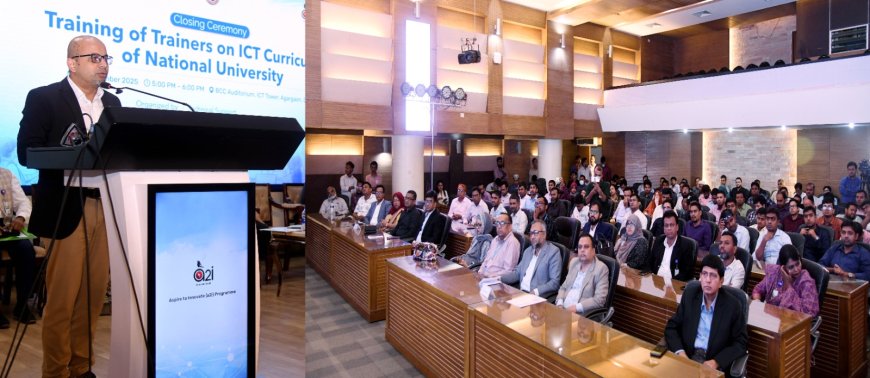



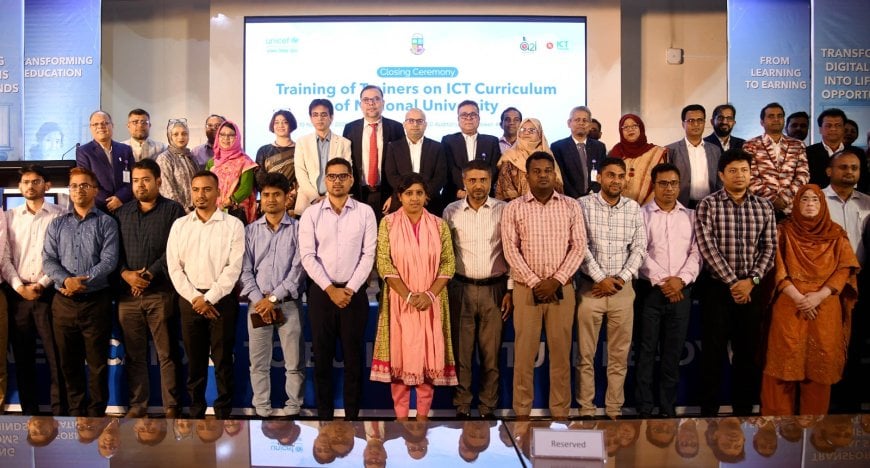
The Aspire to Innovate (a2i) Programme under the ICT Division has completed the first phase of Core Trainer Training for 90 lecturers from various regions across the country, focusing on the ICT curriculum of the National University. Supported by UNICEF Bangladesh, these trained lecturers will soon train 900 master trainers, who in turn will facilitate ICT education for approximately 12,000 college teachers nationwide.
At the closing session, however, participants emphasized the need to regularly update the training manual to keep pace with time and called for the introduction of postgraduate programs in ICT under the National University.
The closing ceremony was held on Monday, 10 November, at the BCC Auditorium in the ICT Tower, Agargaon, with the ICT and Telecom Adviser to the Chief Adviser, Faiz Ahmad Taiyeb, attending as the Chief Guest.
While presenting honorary certificates to lecturers Sonali Dash of Dinajpur Government College and Omar Sharif Raihan of Chattogram College, the Special Assistant remarked that the National University remains “neglected and somewhat undermined.” He stated, “If the National University is not uplifted, Bangladesh cannot progress. The introduction of the four-year honors program during a demographic turning point was a groundbreaking decision.”
Faiz Ahmad Taiyeb recommended introducing certification courses in technology across the 2,500 colleges affiliated with the National University. He also assured that an ICT cell would be opened within a2i to provide technical support to the university.
“It is unfortunate that the National University still lacks computer labs,” he added. “We will begin establishing these on a limited scale immediately. Beyond a four-credit structure, we must move forward to integrate AI and cloud technologies to meet national needs.”
He further noted, “To elevate Bangladesh, the National University must be elevated. Digital transformation cannot leave National University students behind.”
The event was presided over by ICT Division Secretary Shish Haider Chowdhury. Distinguished guests included National University Vice-Chancellor Professor Dr. ASM Amanullah, Dr. Kaiyum Ara Begum, Member of the Socio-Economic Infrastructure Division of the Bangladesh Planning Commission, and Press Secretary to the Chief Adviser Mohammad Shafiqul Alam.
Additional guests included UNICEF Bangladesh Deputy Representative Deepika Sharma, a2i Project Director Md. Abdur Rafeq, and Additional Secretary of the ICT Division Mohammad Mamunur Rashid Bhuiyan.
a2i Program Management Lead Abdullah Al Fahim presented details of the training initiative.
During the discussion, Lecturer Habibur Rahman of Madaripur Government College called for regular updates to the training manual, maintaining curriculum continuity from primary to college level, and ensuring recruitment and promotion of technical educators.
Trainer Nasima Akhter stated that degree programs in ICT should be introduced in every university across the country without delay.
A representative of UNICEF Bangladesh noted, “We are not only training teachers; we are building the foundational strength for Bangladesh’s future digital transformation.”
National University Vice-Chancellor Professor Dr. ASM Amanullah observed, “In the past, governing bodies have severely damaged educational institutions. We are not trying to build Oxford now—we want to transform into a regional university similar to those in Singapore, India, and Pakistan. Over one and a half hundred subjects are taught, yet there is no industry linkage. Therefore, we are working to teach students language and technology skills. We have already established language clubs. Now, computer labs are needed across our 2,500 colleges.”
Emphasizing technical literacy, Press Secretary Shafiqul Alam stated, “Automation is changing industries. In ceramics, robots are replacing workers. Traditional subjects like political science, philosophy, and BBA are no longer sufficient. It is time to teach languages such as Japanese, Korean, Chinese, and Arabic, and develop skilled professionals in computing, AI, and robotics.”
In his concluding remarks, ICT Division Secretary Shish Haider Chowdhury said, “Often, technological planning does not reach classrooms. This training will help reduce that gap and ensure technology is directly disseminated to students through trained educators.”
According to the organizers, the core objective of this training was to prepare lead trainers to implement the ICT curriculum, conduct blended learning classes, use digital tools effectively, and establish standardized assessment frameworks. The training also laid the groundwork for master trainer programs and the subsequent rollout across all colleges.
To support effective implementation, the National University, with a2i’s cooperation, prepared an ICT course implementation guideline on 3 September. With UNICEF’s support, a blended (online and face-to-face) training model has been developed, under which national-level core trainers are being trained. In the next phases, these trainers will train master trainers and college-level educators, gradually expanding ICT capacity nationwide.









