





































Graduate Glut and Global Opportunities: NRB Conclave 2024 Insights
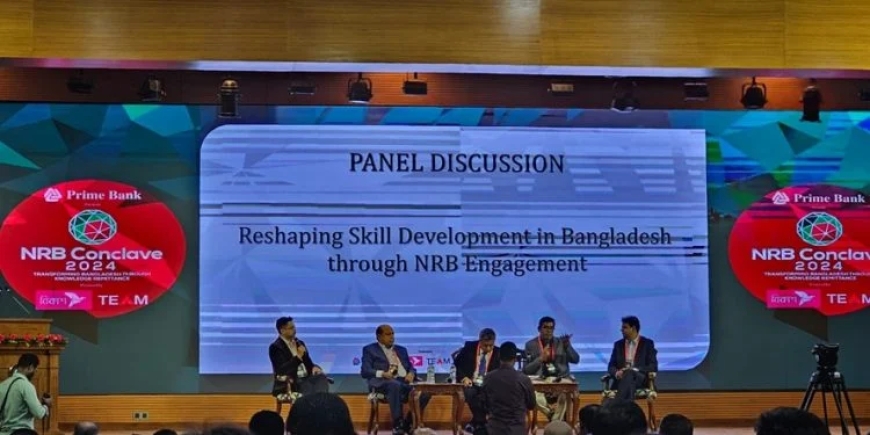



At the NRB Conclave 2024, Fahim Mashroor, Managing Director of the online job platform BD Jobs, raised critical questions during a panel discussion about the growing number of unemployed graduates in Bangladesh and the structural transformation of the economy. He highlighted that 50% of university graduates in the country remain unemployed for at least a year, and 37% of them are over the age of 30. Despite this, STEM education continues to suffer from a skills gap. Each year, approximately 7–8 lakh people leave the country, while the workforce grows by 23–24 lakh, including 7.5 lakh graduates annually. Twenty years ago, this number was around three lakh.
Mashroor argued, “There is no shortage of skilled manpower in the country. The problem lies in expectations and aspirations. We have created issues for ourselves.” Citing statistics, he pointed out that in 2012, 3.85% of Bangladesh’s total workforce consisted of graduates, compared to 3.5% a decade earlier. While the percentage increase was minimal over ten years, the absolute number of graduates has tripled in the last decade, far outpacing the capacity of institutions to accommodate them. He added, “In the next five years, we still won’t have enough capacity to absorb these graduates. We either need to turn them into entrepreneurs or send them abroad.”
Mashroor emphasized the role of expatriates in addressing graduate unemployment: “Diaspora members can connect graduates with HR managers abroad and push for skill development. This is how Indian expatriates have positioned themselves at the top.”
The discussion, moderated by RTS Enterprise CEO Zisan Kingshuk Haque, included panelists like Tarin Anwar, President of Joy Grains & Company; Mohammad Walid Hossain, Additional Secretary of the Finance Division; and Mostaq Ahmed, founder of NybSys in the USA.
Mostaq Ahmed shared his experience, stating that despite global STEM education exceeding 40%, Bangladesh remains below 15%. He noted that after interviewing 300 candidates for a position, he had to hire employees from Spain due to the skills gap in Bangladesh. Over the past 15 years, he has facilitated the migration of many skilled workers abroad. Ahmed suggested increasing interest in science and mathematics among students to address the issue, citing the potential for innovation in Bangladesh. He added, “Engineers from Bangladesh, with no prior experience, successfully worked on Intel’s GenAI Dell integration for the Mobile Congress last year, proving their potential. However, institutional migration often comes with significant costs, and trust remains a challenge between employers and employees.”
Mohammad Walid Hossain highlighted the Finance Ministry’s efforts over the last eight years to implement skill development projects funded by ADB. He noted that programs like the Skills for Employment Investment Program (SEIP) have created 800,000 jobs and that the ministry has launched the Skills for Industry Competitiveness and Innovation Program (SICIP) to continue this progress. However, despite these initiatives, 52,000 students went abroad for education in 2023, and many do not return. Hossain proposed involving expatriates in skill development and initiating a “Brain Circulation Program” to bring back overseas engineers and scientists. He further stressed the importance of creating better opportunities in the country to retain talent.
Tarin Anwar shared insights from the corporate sector, pointing out the lack of local experience among professionals. She emphasized the need for cross-cultural exposure and reverse brain drain, citing China as an example, where 80% of students studying in the USA return to contribute to their homeland. Anwar suggested honoring accomplished expatriates such as Salman Khan of Khan Academy, Jawed Karim, co-founder of YouTube, Zahid Hasan, Professor of Physics at Princeton University, and Omar Ishrak, Chairman of Intel, with awards like the Independence Award to inspire others.
The seminar also proposed forming a forum to increase expatriate involvement in developing Bangladesh’s STEM and tech sectors. Discussions concluded that connecting graduates with multinational companies and facilitating employment abroad would generate more revenue for the country compared to solely focusing on local employment.
In a separate session, Chaudhury Ashiq Mahmud Bin Harun, Executive Chairman of BIDA and BEZA, discussed the future of Bangladesh’s economy and expatriate engagement. Other notable speakers included Shahriar Pavel, Chief Experience Officer of Huawei Consumer Business Group, UAE, who moderated a session on NRB CIP 2025.









