





































Integrating Islamic Ideals in Modern Medicine for a Moral and Sustainable Healthcare System



Incorporating Islamic principles into modern medical systems can pave the way for a moral and sustainable healthcare framework for humanity. Islamic medical education harmonizes scientific knowledge with ethical and spiritual values. Its philosophy shapes physicians who not only focus on curing diseases but also emphasize social well-being and moral integrity. At its foundation lies Tawhid, the unifying principle that connects human life, society, and medicine as one integrated system.
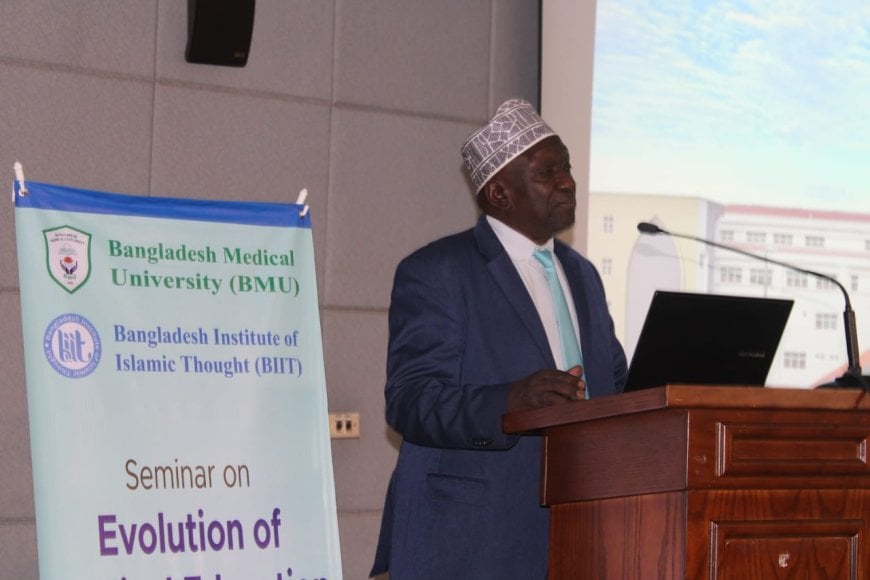
These reflections came from Professor Dr. Omar Hasan Kasule, an internationally renowned scholar and Secretary General of the International Institute of Islamic Thought (IIIT), while delivering the keynote speech at a seminar titled “Evolution of Islamic Medical Education and Ethical Practice” held at Bangladesh Medical University (BMU).
The seminar took place on Saturday, October 18, 2025, at the School of Science and Health Lecture Hall. The event was presided over by the Vice Chancellor of BMU, Professor Dr. Md. Shahinul Alam. Among others, Pro-Vice Chancellor (Research and Development) Professor Dr. Md. Mujibur Rahman Howlader, Pro-Vice Chancellor (Administration) Professor Dr. Md. Abul Kalam Azad, Senior Academic Fellow of IIIT Professor Dr. Abu Khaldun Al-Mahmud, and BMU Treasurer Professor Dr. Nahrin Akhter also spoke. Nearly 300 faculty members, researchers, and students attended the seminar.
Professor Dr. Omar Hasan Kasule discussed the development of value-based medical education, the historical evolution of ethical practice, the importance of moral observance, professional accountability from an Islamic philosophical standpoint, the role of spiritual consciousness in the medical profession, the Islamization of medicine, and the humane dimensions of doctor-patient relationships.
He remarked, “Integrating Islamic knowledge, ethics, and values into medical education is highly timely, as it will make the medical profession more humane and responsible. The cultivation of moral consciousness and ethical values among physicians will render the profession more meaningful. Therefore, it is essential to formulate a comprehensive action plan and strengthen international collaboration in the coming days.”
Professor Kasule elaborated that the science of Islamic ethics is based on the five objectives (Maqasid al-Shariah): preservation of faith (Deen), life (Nafs), progeny (Nasl), intellect (Aql), and wealth (Maal). “A physician must ensure that all actions are Islamically permissible in light of these five objectives,” he said. To fulfill these objectives, a doctor’s actions must satisfy five practical conditions—Qasd (intention), Yaqin (certainty of success), Darar (consideration of possible harm), Mashaqah (awareness of hardship or constraint), and Urf (established social practice).
He explained, “In fact, the principles of Maqasid al-Shariah and Qawaid al-Shariah make Islamic ethics far broader and more firmly grounded than European ethics.”
He further stated, “Islam directs every aspect of life and knowledge toward the pleasure of Allah. From that perspective, the Islamization of medicine is essential. Islamic medicine represents a universally moral healthcare system consistent with the Qur’an and Sunnah. In the 1960s and 70s, Islamic Medical Associations inspired a new consciousness among Muslim doctors, which led to the formal definition of ‘Islamic Medicine’ in Malaysia in 1995. Today, Islamic hospitals and Shariah-compliant healthcare centers worldwide are ensuring worship-friendly environments, spiritual comfort, and ethical medical practice. In Malaysia and Indonesia, such hospitals have received official recognition as Shariah-compliant institutions. Emerging ethical dilemmas in medicine—such as organ transplantation, genetic engineering, in-vitro fertilization, and life-support technologies—cannot be resolved by traditional jurisprudence alone. New ijtihad is needed in light of Maqasid al-Shariah, or the higher objectives of Islamic law.”









