




































AI and Ethics: Aligning Artificial Intelligence with Islamic Insight
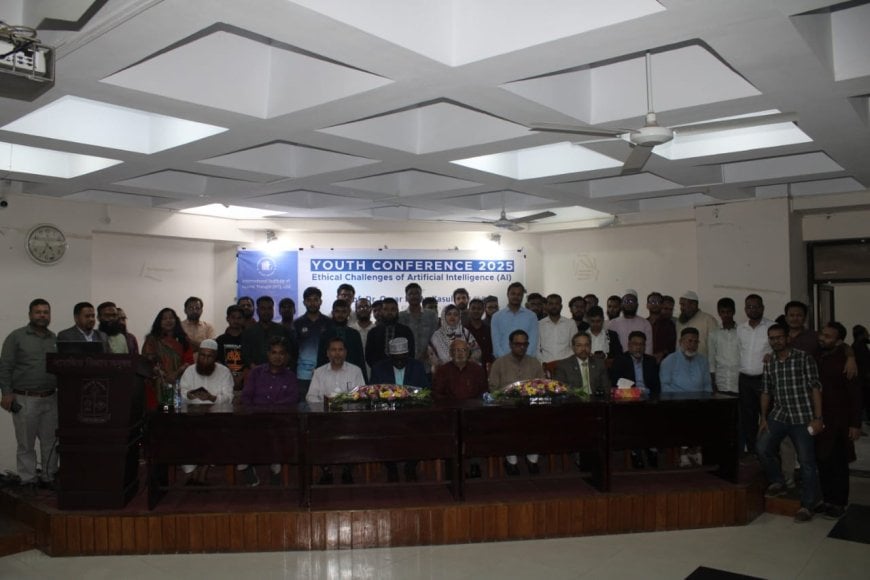



A youth conference titled “Ethical Challenges of Artificial Intelligence (AI)” was held at the Professor Muzaffar Ahmad Chowdhury Auditorium of the Faculty of Social Sciences, University of Dhaka.
The event, jointly organized by the Bangladesh Institute of Islamic Thought (BIIT) and the International Institute of Islamic Thought (IIIT), took place on Saturday, October 18, 2025. The keynote address was delivered by Professor Dr. Omar Hasan Kasule, a faculty member of King Fahad Medical City, Saudi Arabia, and Secretary General of IIIT, USA.
Professor Kasule discussed the ethical challenges of artificial intelligence, its social implications, and the importance of employing technology for human welfare in light of Islamic moral principles.
He stated, “AI must be used under ethical control and for the purpose of human welfare. As artificial intelligence brings new dimensions to moral and humanitarian questions, we must address these challenges consciously and with competence. The use of AI in medical science, in particular, creates an ethical risk of losing human control.”
From Islamic, legal, and technological perspectives, he explained that Allah created human beings as the best of all creation, endowed with five distinctive attributes that grant superiority over other beings: Istikhlaf (vicegerency), Haml al-Amanah (responsibility), Taskhir (control and subjugation of creation), Istimar (civilization-building), and Akhlaq (morality). “Through these five attributes, humans have created technology—and it remains their ethical responsibility to keep it under control,” he said.
He elaborated, “Modern artificial intelligence is no longer merely an aid; it can learn, make decisions, and even create new diagnostic solutions. This raises a profound question—are humans still the controllers, or are machines beginning to take control? Such a shift in control could jeopardize the very moral supremacy of humanity.”
Dr. Kasule raised a critical question of ethical accountability: “If AI makes an error in medical diagnosis and causes harm to a patient, who is responsible—the programmer, the software vendor, the hospital owner, or the physician? The answer cannot be sought solely through technological analysis; it must emerge from an integrated framework combining Fiqh (Islamic jurisprudence) and moral reasoning.”
He emphasized that, “From an Islamic perspective, human beings can never surrender their moral agency or judgment to machines. AI is merely a tool of Taskhir (utility and facilitation), not of authority or control.”
Warning against blind technological competition and profit-driven innovation, Professor Kasule said, “Unrestrained technological rivalry and profit-centric innovation could endanger the future of humanity. The solution lies in carefully observing real-world consequences before making decisions and maintaining a judicious balance between benefit and harm. According to Fiqh, preventing harm takes precedence over acquiring benefit. Technology guided by moral responsibility and divine wisdom will form the foundation of a sustainable human civilization.”
The conference was also attended by BIIT Director General Professor Dr. M. Abdul Aziz, alongside university teachers, researchers, students, young professionals, and participants from various disciplines.









