



































Propaganda and Protection: Experts Urge Cyber Awareness Amid AI Threats



Artificial Intelligence (AI), deepfakes, and photo cards are being used not only to spread negative propaganda but also to push positive narratives on social media. Experts have warned that such political propaganda is rising ahead of the national parliamentary election and called upon both government and private institutions, including political parties, to launch cyber awareness initiatives to counter potential security risks stemming from technology misuse.
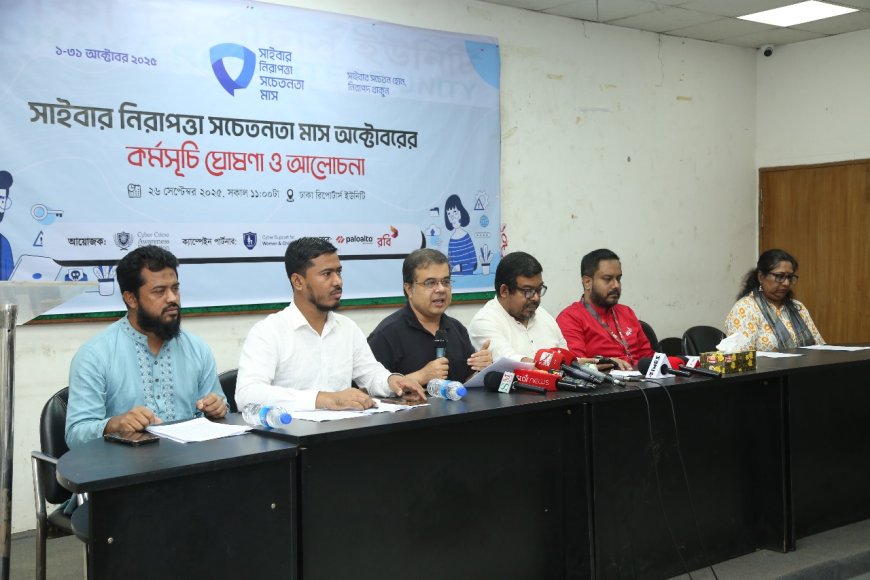
The call was made at an event marking the launch of the 10th nationwide Cybersecurity Awareness Campaign, organized by the Cyber Crime Awareness Foundation (CCAF) throughout October.
Under the theme “Be Cyber Aware, Stay Secure,” this year’s Cybersecurity Awareness Month October 2025 will be held with support from the 12-organization platform, Cyber Support for Women and Children. The month-long campaign is being implemented with sponsorship from mobile operator Robi Axiata PLC and technology company Palo Alto Networks.
The inauguration ceremony took place on Friday (September 26) at the Dhaka Reporters Unity, attended by technology experts from both government and private sectors. The event was presided over by CCAF adviser and computer network engineer Syed Zahid Hossain, while CCAF President Kazi Mustafiz conducted the session. Engineer Md. Mushfiqur Rahman, Member-Secretary of the National Committee on Cybersecurity Awareness, outlined the campaign activities. Other speakers included Abul Hasnat Mohammad Shafi Ullah, Senior General Manager of Robi’s Cybersecurity Planning Division; Taposi Rabeya, Deputy Director (Client Support and Mediation) of BLAST; and Md. Asif Islam, Assistant Director of the National Cybersecurity Agency.
Abul Hasnat Mohammad Shafi Ullah remarked, “Technology has no boundaries. Just as people elsewhere in the world are being deceived, so are we. Therefore, there is no alternative to awareness. The level of awareness must match the level of social media usage.”
Syed Zahid Hossain noted, “Fake information spread on social media often carries political motives. Many parties or individuals deliberately disseminate such posts to undermine opponents.”
Mushfiqur Rahman emphasized, “Our knowledge of technology is still very limited. We must think about developing our own technologies and move forward using them. Many falsehoods are being spread using photo cards created with Artificial Intelligence (AI). Such content should not be shared without verification.”
Taposi Rabeya observed, “Not only less-educated people in villages, but also many highly educated individuals in cities are facing online sexual harassment. More than 15–25 percent of victims do not seek legal help because they feel they were targeted due to their own lack of awareness.”
Quoting CCAF’s 2024 research report, Mushfiqur Rahman said that the majority of cybercrime victims—78.78 percent—were between 18 and 30 years of age, with nearly 59 percent being women. The most common crime, at 21.65 percent, involved hacking and hijacking of social media and online accounts. He further noted that the category of “other” types of cybercrimes has sharply increased, reaching 11.85 percent in the latest report—almost double the previous year’s figure—indicating the rise of new and unfamiliar threats.
Among victims, 47.72 percent suffered social humiliation, 40.15 percent faced financial losses, and nearly all endured psychological distress. Yet only 12 percent pursued legal action, with 81.25 percent filing general diary entries and 18.75 percent submitting written complaints. Of those, 87.50 percent expressed dissatisfaction with law enforcement responses.
The findings also showed that most victims were educated: 40.90 percent had passed higher secondary level, 21.21 percent held bachelor’s degrees, 16.66 percent were secondary graduates, while 12.87 percent had less than secondary education.
Given these realities, experts stressed that the 10th Cybersecurity Awareness Month in October 2025 holds particular significance for Bangladesh. Since 2016, CCAF has organized awareness campaigns in line with global observances of October as Cybersecurity Awareness Month. This year, CCAF has officially joined the campaign led by the U.S. National Cybersecurity Alliance.
Throughout the month, awareness drives will highlight four essential practices: password management, multi-factor authentication, keeping software updated, and avoiding suspicious links. Experts warned that failure to follow these basic rules could result in serious harm not only to individuals and institutions but also to the state itself.









