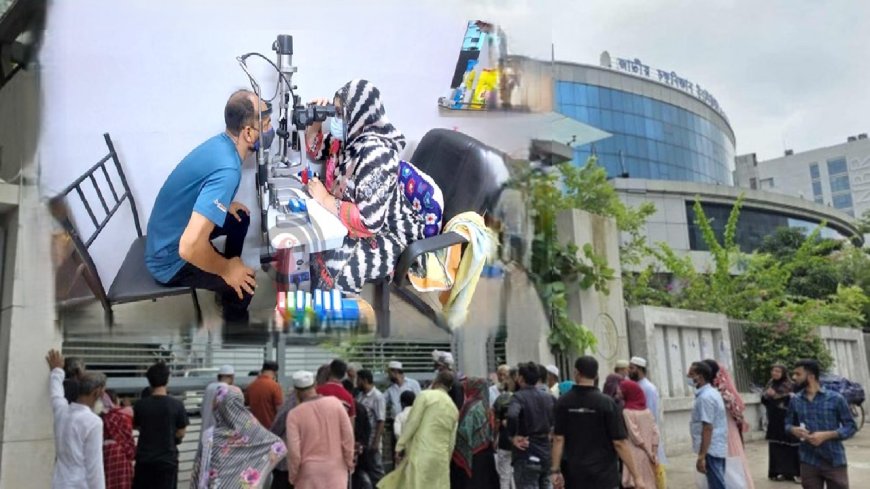
The National Institute of Ophthalmology and Hospital in Dhaka resumed full operations on Saturday, June 14, after remaining closed for 18 consecutive days. From early morning, lines of patients were seen at the hospital premises, and doctors, nurses, and other staff began providing medical services to the best of their capacities.
According to hospital sources, in addition to offering consultations and general treatment, patients requiring admission are also being admitted as needed.
The closure followed a dramatic incident on May 25, when four injured participants of the July Movement, who were under treatment at the hospital, attempted suicide by ingesting poison during a meeting in the office of the hospital director. The individuals had reportedly accused the hospital of medical negligence and inadequate care. They were immediately transferred to Shaheed Suhrawardy Medical College Hospital, where they recovered following emergency treatment.
Three days later, on May 28, the injured July Movement activists began a protest demanding advanced treatment abroad and other facilities. On the same day, an altercation broke out between some hospital staff and general patients over various alleged irregularities. The injured protestors joined the confrontation, resulting in a three-way clash. In response, hospital officials and employees held a human chain demonstration. Subsequently, all hospital services were suspended, and even admitted patients left the facility.
Following several rounds of negotiations, the hospital’s emergency department reopened on June 4. Most recently, the outpatient department resumed services on June 13.
It is worth noting that since the events of the July Movement last year, 686 injured protestors have sought treatment at the National Institute of Ophthalmology and Hospital. Among them, 525 individuals lost their vision due to birdshot injuries. A total of 32 patients lost sight in both eyes, while 493 suffered complete blindness in one eye. Additionally, two patients sustained severe visual impairment in both eyes, and 47 others suffered serious vision loss in one eye.